How Does the UniFirst Acquisition Affect Uniform Programs?
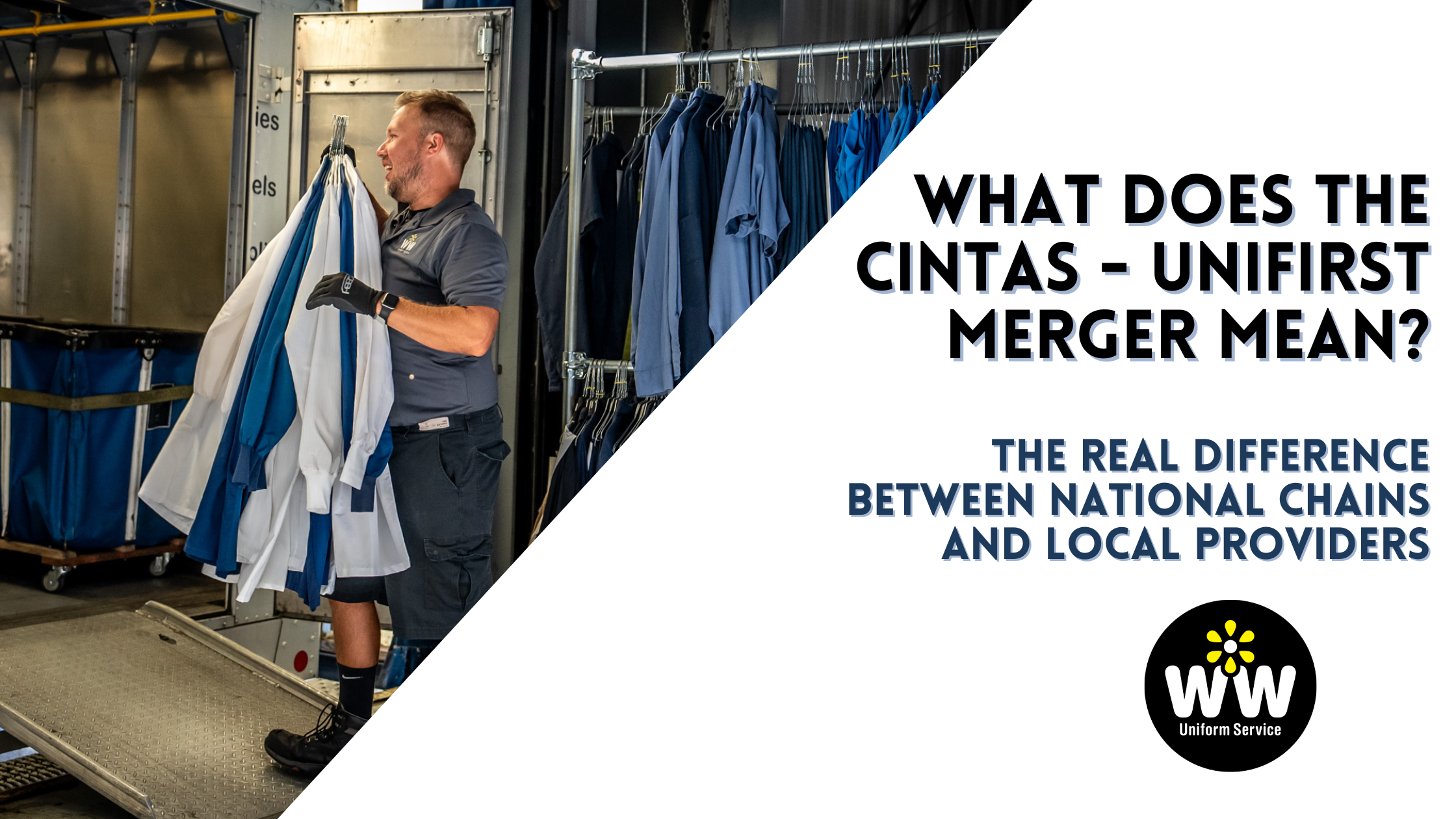
If you're a UniFirst customer, you've probably heard the news by now. In March 2026, Cintas and UniFirst announced a definitive agreement for Cintas to acquire UniFirst in a deal valued at approximately $5.5 billion. The combined company would serve approximately 1.5 million business customers across North America. It's a big deal and if your operation depends on reliable uniform service, it's worth paying attention to what comes next.
Here's what we know, what history tells us, and the questions every UniFirst customer should be asking right now.
What Happened With the Recent Uniform Industry Merger
This was Cintas' third attempt at acquiring UniFirst, after previous bids fell through in 2022 and again in early 2025. The persistence alone tells you something about how much Cintas wanted this deal.
The merger agreement was unanimously approved by both companies' boards of directors, and the transaction is expected to close in the second half of calendar year 2026, pending UniFirst shareholder approval and regulatory sign-off.
What "Synergies" Usually Mean for Customers
When two large competitors merge and start talking about hundreds of millions in cost savings, it's worth asking: where does that money come from?
In most large-scale consolidations, the answer involves streamlining routes, consolidating processing facilities, standardizing service offerings, and often restructuring the customer-facing teams that you've built relationships with over the years. Yep, that means your route driver, your account rep, and the person who picks up the phone when something goes wrong.
None of that is guaranteed to stay the same after a merger of this scale. And in the uniform rental business, where the relationship between your team and your service provider is built on trust, consistency, and responsiveness, that matters a lot.
Questions Every UniFirst Customer Should Be Asking Right Now
You don't need to make any decisions today, but you do need to start asking the right questions because the time to evaluate your options is before a service disruption happens, not after.
- Who will my account contact be after the merger closes? Consolidations almost always mean personnel changes. Find out whether your current rep, your route driver, and your day-to-day contacts will still be in place, and if not, what the transition plan looks like.
- Will my service agreement change? Mergers can trigger contract reviews. Read your current agreement carefully and ask whether the terms, pricing, and service levels you have today are protected during and after the transition period.
- How will my deliveries be affected? Route restructuring is one of the most common outcomes of a merger like this. Ask directly whether your scheduled pickup and delivery days will stay the same and when you'll be notified if they change.
- What are my options if service quality changes? This is the one most customers forget to ask. Review your contract for notice periods, termination clauses, and what flexibility you have if things don't go as planned after the merger closes.
The Local vs. National Difference When Things Get Complicated
There's a lot of marketing language thrown around about being "local." But a merger like this puts the real difference in clear view.
When you work with a large national provider, you're one account in an enormous portfolio. Decisions that affect your service such as route changes, facility consolidations, pricing adjustments, staffing, are made at a corporate level, far removed from your facility and your team. When something goes wrong, you're navigating a phone tree, not calling someone who knows your operation by name.
We've heard this story directly from businesses who've made the switch to us after working with national chains — uniforms lost, charges for replacements that weren't their fault, and weeks of back-and-forth to get things sorted out. That's not a knock on any one company, it's just the nature of operating at that scale, especially during a period of significant organizational change.
A local provider doesn't have that problem. If something goes sideways like a missed delivery, a garment issue, or a compliance question, you get a real person on the phone who has the authority to fix it right then and there.
How WW Approaches Uniform Service Differently
We've been doing this for over a century, so we’ve seen a thing or two in this industry! We're family-owned, and we've built our business serving manufacturing operations, automotive facilities, food processing plants, and more across Connecticut, Massachusetts, Rhode Island, and New York.
With over 100 years under our belt, we’ve learned what our customers really want. We don't answer to shareholders. We answer to you.
Here's what that looks like in practice:
Our billing is straightforward. No hidden fees, no surprise charges. Based on feedback from our own customers, 100% report satisfaction with the clarity and accuracy of their invoices. That's not something you see from big national providers.
Our deliveries show up. When you need your uniforms, they're there backed by our RFID tracking. And if anything ever doesn't go as planned, you're not waiting days to hear back, you're talking to our team directly, right when you need them.
Our programs are flexible. We're not trying to lock you into something that only works for us. We build programs around how your operation actually runs, and 99% of our customers say they're likely to renew with us, not because they're stuck, but because the service is worth it.
This Might Be the Right Moment to Take a Look at Your Options
If you're a UniFirst customer, now’s the right moment to review your service agreement, ask the questions, and take stock of whether your current uniform program is set up to keep running smoothly through a major corporate transition.
If you've been meaning to compare providers, or if you want to understand what a locally managed program would actually look like for your operation, we're happy to have that conversation with no pressure and no hard sell.
Reach out to us today and let's talk about what the right program looks like for you.
More Blog Posts You May Be Interested In

Cold-Weather Workwear: What Belongs in a Winter Uniform Program?

How Comfortable Manufacturing Uniform Programs Improve Morale

Benefits of Microfiber: Why More Manufacturers Are Making the Switch

Uniforms for Restaurants: What to Expect From Your Provider

National Safety Month: Why Your Uniform Program Is Part of Your Safety Plan